 robotindex
 Pollen Robotics Reachy 2
A wheeled, dual-arm humanoid research robot from Pollen Robotics of Bordeaux, France, acquired by Hugging Face in April 2025. Two 7-DOF arms built from Orbita parallel actuators, a 3-DOF neck with motorized antennas, parallel grippers, and a manually height-adjustable torso sit on an optional omnidirectional lidar base. It is programmed through ROS 2 or a Python SDK, supports VR teleoperation, and integrates with Hugging Face's LeRobot. Aimed at labs doing embodied-AI and human-robot-interaction research, not at home users.
Manufacturer page — pollen-robotics.com →
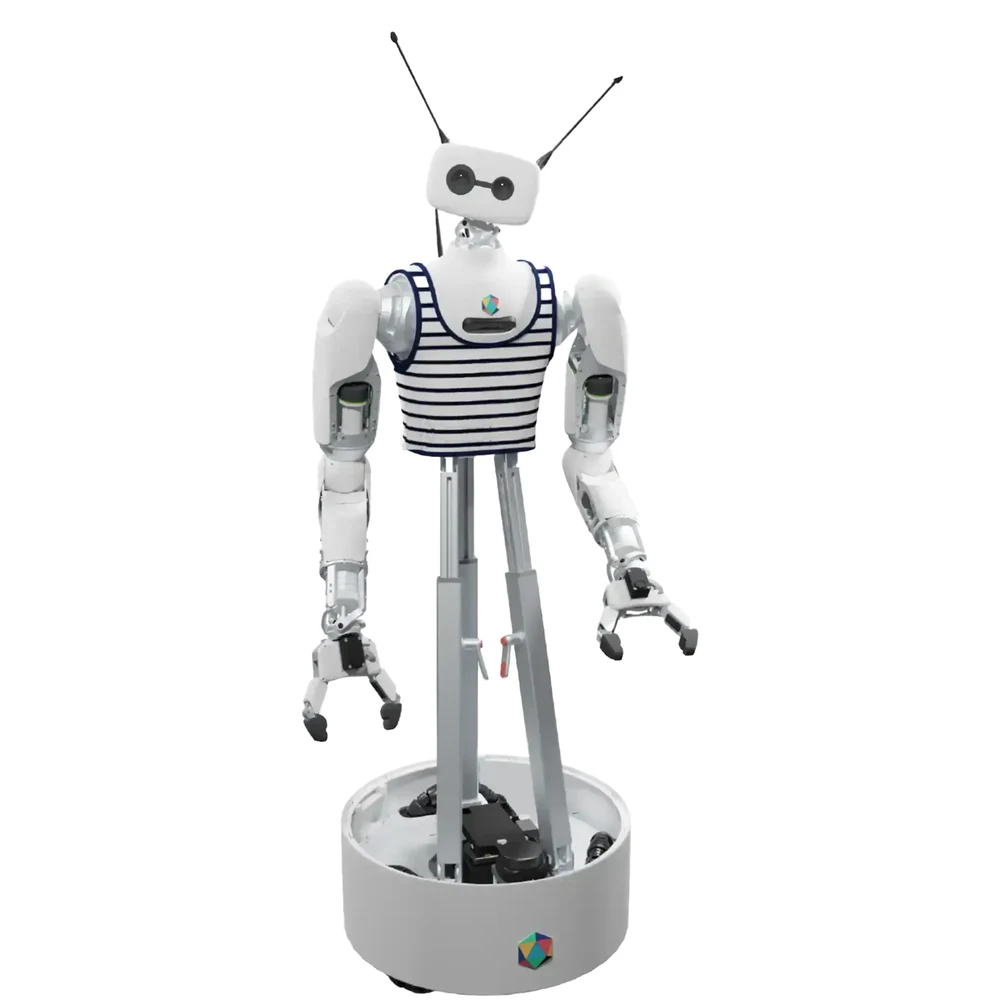
Image: Pollen Robotics (full dual-arm mobile-base configuration)
Specs
Degrees of Freedom
172 × 7-DOF arms + 3-DOF neck; grippers and antennas extra
Arms
2 × 7 DOFOrbita 2D (shoulder, elbow) + Orbita 3D (wrist)
Payload
~3 kgPer arm
Height
136–166 cmManually adjustable
Weight
~50 kgFull robot; base ~25 kg
Compute
Bedrock V3000SolidRun fanless CPU PC; AI runs on your own computer
Sensing
Stereo + depthHead stereo cameras, torso RGB-D, mics, lidar on base
Battery
8–10 h24 V base battery; runtime differs by source
Chassis
Omni baseThree omniwheels with lidar (optional)
Reference Price
Hugging Face's April 2025 announcement lists Reachy 2 at $70,000, ordered by emailing Pollen's sales address. At the October 2024 launch, coverage reported $75,000 for the full robot with mobile base and $38,000 for a stationary one-arm model; those figures are secondary and may be out of date. Pollen sells modular configurations (one arm or two, with or without the mobile base), so the final price depends on the setup, and current quotes should be requested directly. robotindex does not sell this product.
Insights
Reachy 2 launched in October 2024 as the successor to the original Reachy (2019/2021/2023 generations). It is built around Pollen's in-house Orbita actuators, which place two or three motors in a parallel mechanism so a single joint moves on 2 or 3 axes. Early adopters include Cornell University and Carnegie Mellon University. Since the Hugging Face acquisition, Reachy 2 has been supported in LeRobot for data recording, training, and evaluation. The Open Source badge is applied because Pollen describes both the hardware design and the software as open: the ROS 2 stack, Python SDK, and core repositories are Apache 2.0 on GitHub. The robot is a research-grade, $70,000-class product, so its place in this directory is the high end of the wheeled humanoid category; compare it with Galaxea R1 Pro, which has a similar price and layout but closed hardware.
Verified against Pollen Robotics' Reachy 2 product page, its documentation specs page (docs.pollen-robotics.com), its GitHub repositories (reachy2_core, reachy2-sdk), the Hugging Face acquisition post, and third-party spec sheets (RoboZaps, Anton Robots, Maxon, Robots Guide, DeepLearning.AI), as of October 2026. Flagged as uncertain: battery runtime is "up to 8 hours" on two spec sheets and "around 10 hours" in the Hugging Face-era press coverage; DOF is 17 on one spec sheet and 18 on another, which appears to count a base axis, so 17 is used; gripper opening of about 100 mm and force of 10 N nominal / 50 N peak come from a single third-party review and are not shown above. The Open Source badge rests on Pollen's own page stating open hardware under Apache 2.0, which was not independently confirmed in a CAD repository; one third-party aggregator describes hardware open-sourcing as planned rather than done, so treat the hardware claim as manufacturer-stated. The image shows the dual-arm mobile-base configuration; the mobile base and arm count are optional. Product image: Pollen Robotics. The floating third-party logo and watermark on the supplied image were removed; the Pollen logos on the robot itself were left in place.